Hot and Cold PCSO Numbers: A Practical 28-Draw Example
Why 28 Draws Is Enough to Spot a Pattern (But Not Predict a Winner)
If you’ve been playing PCSO lotto games like Ultra Lotto 6/58, Grand Lotto 6/55, or Super Lotto 6/49, you’ve probably heard other bettors talk about “mainit” and “malamig” numbers. Hot numbers are those that appear frequently in a given set of draws. Cold numbers are those that show up rarely. Neither guarantees a win, but tracking them can be a fun way to guide your number selection—especially if you’re tired of playing the same birthday combinations every week.
In this practical example, we looked at the last 28 draws across recent PCSO lotto games. That’s a decent sample size for a casual player: long enough to see which numbers are trending, short enough to stay relevant. The table above summarizes the results, and we’ll walk through what those frequencies actually mean for your next bet.
Before we go further, a quick reality check: lottery draws are random. Every number has the same chance of being drawn in the next game, regardless of what happened in the last 28. The stats here are for entertainment and strategy exploration, not a system that beats the odds. Think of it as a way to add structure to your picks, not a magic formula.
| Hot number | Times | Cold number | Times |
|---|---|---|---|
| 15 | 3 | 06 | 1 |
| 20 | 3 | 04 | 1 |
| 23 | 3 | 03 | 1 |
| 13 | 2 | 55 | 1 |
| 31 | 2 | 48 | 1 |
| 35 | 2 | 44 | 1 |
| 38 | 2 | 43 | 1 |
| 39 | 2 | 40 | 1 |
| 41 | 2 | 32 | 1 |
| 42 | 2 | 29 | 1 |
The Hot List: 15, 20, and 23 Lead the Pack
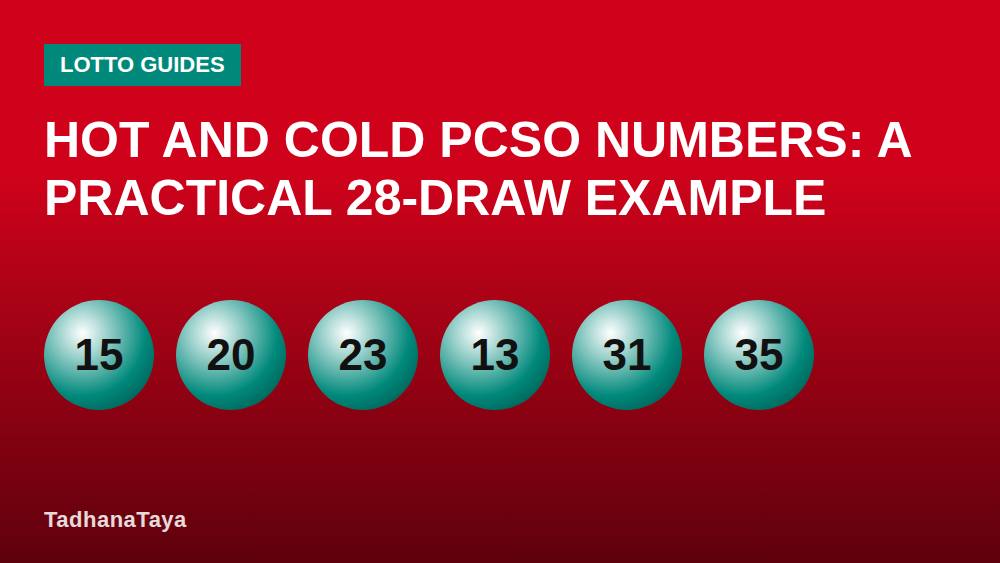
Based on the 28 draws we analyzed, three numbers stood out: 15, 20, and 23—each appeared 3 times. That’s a frequency of about 10.7% per number, which is higher than the expected average if all numbers were equally likely. Of course, in a small sample, a few numbers will naturally rise to the top. But for bettors who like to ride the wave, these three are the clear headliners.
Right behind them is a cluster of seven numbers that each hit twice: 13, 31, 35, 38, 39, 41, and 42. That’s a solid group of “warm” numbers. If you’re building a combination and want to lean on recent frequency, pulling two or three from this group could feel more grounded than picking purely at random.
How to Use the Hot Numbers Without Overthinking
One practical approach is to pick one or two hot numbers as anchors, then fill the rest of your combination with a mix of cold and neutral numbers. For example, if you’re playing a 6-number game, you might choose 15 and 23 as your anchors, then add 13, 38, and two cold numbers like 06 and 55. This gives you a blend of recent frequency and low-frequency contrast.
Another idea: play a “hot pair” system. Since 15, 20, and 23 are the top three, you could form pairs like 15-20, 15-23, and 20-23, then combine each pair with four other numbers. This is purely a structural choice—it doesn’t change the odds, but it makes your ticket feel more intentional.
Remember: even the hottest number can go cold for weeks. Frequency is a snapshot, not a forecast.
The Cold List: 06, 04, and 03 Are Due (Or Are They?)
On the flip side, the table above shows ten numbers that appeared only once in the last 28 draws: 06, 04, 03, 55, 48, 44, 43, 40, 32, and 29. Among them, 06, 04, and 03 are the coldest of the cold—each with a single appearance. Some players love these numbers because they believe in the “due” theory: if a number hasn’t come out in a while, it’s more likely to appear soon. Statistically, that’s not true. Each draw is independent, and the ball doesn’t remember its history.
That said, cold numbers can be useful for balancing your picks. If you’ve been playing mostly hot numbers and not winning, switching to a cold-heavy combination might feel like a fresh start. It won’t improve your odds, but it can break a mental rut.
A Practical Example: Mixing Hot and Cold
Let’s say you want to play 6/49. You could choose three hot numbers (15, 20, 23), two warm numbers (13, 38), and one cold number (06). That’s six numbers total. Or you could go the opposite way: pick three cold numbers (06, 04, 55), two warm (31, 42), and one hot (20). Both approaches are valid as entertainment. The key is to decide on a system and stick with it for a few draws, so you’re not just reacting randomly.
Another angle: use cold numbers as your “wildcards.” If you’re playing multiple tickets, assign one cold number to each ticket. That way, if any of them suddenly heats up, you’re covered. It’s a low-cost way to diversify.
What the Table Really Tells You (And What It Doesn’t)
The table above is a frequency distribution. It shows how many times each number appeared in 28 draws. What it doesn’t show is the order of appearance, the specific game, or the date of each draw. That’s important because different PCSO games have different number ranges. For example, 55 is the highest number in Grand Lotto 6/55, but it doesn’t exist in Super Lotto 6/49. So when you see 55 on the cold list, it only applies to games that include 55.
Also, 28 draws is a small window. In a full year, a number might appear dozens of times. A number that looks hot now could cool off next month. That’s why serious stat-trackers often look at multiple time frames: last 10 draws, last 50 draws, last 100 draws. We chose 28 because it’s roughly a month’s worth of draws for many PCSO games, making it a practical snapshot for casual players.
How to Track Your Own Stats
If you want to go deeper, you can keep a simple spreadsheet. List the draw dates, the winning combination, and then tally frequencies. After a few months, you’ll have your own hot and cold lists. Just don’t expect them to predict the future. Use them to inform your picks, not to dictate them.
You can also check the PCSO website or trusted lotto results sites for historical data. Many sites offer frequency charts that update after every draw. That saves you the manual work.
Smart Picks vs. Random Picks: Finding Your Balance
At the end of the day, every combination has the same probability. A ticket with 15-20-23-13-38-06 has the same chance as 01-02-03-04-05-06. The difference is psychological. Some players feel more confident when they use stats. That confidence can make the game more enjoyable, which is the real point.
If you’re going to use hot and cold numbers, set a budget and stick to it. Don’t chase losses by buying more tickets because a cold number “must” come out. That’s how a fun hobby becomes a problem. Play for entertainment, and treat any win as a bonus.
One practical tip: rotate your numbers every few weeks. If you’ve been playing the same hot numbers and they’ve gone cold, update your list. The table above will change as new draws happen. Stay flexible.
Finally, consider joining a lotto pool with friends or coworkers. You can cover more combinations without spending more. Just make sure you have a clear agreement on how to split any prize.
Frequently Asked Questions
Are hot numbers more likely to win in the next PCSO draw?
No. Each draw is independent, and every number has the same probability. Hot numbers are just those that appeared more often in a specific past period. They can be a fun guide for picking numbers, but they don’t improve your odds.
How many draws should I analyze to find hot and cold numbers?
There’s no perfect number. For a quick snapshot, 20 to 30 draws work well. For a more robust view, you can look at 50 or 100 draws. Just remember that even large samples don’t predict future results.
Should I always avoid cold numbers?
Not necessarily. Cold numbers can add variety to your picks. Some players like to include one or two cold numbers as wildcards. It’s a personal choice, not a strategic advantage.
Where can I find official PCSO draw results?
You can check the official PCSO website or verified lotto results pages. Many sites also provide frequency charts and number generators to help you track stats.